


Ford Bronco vs. Bronco Sport for Fall Adventures
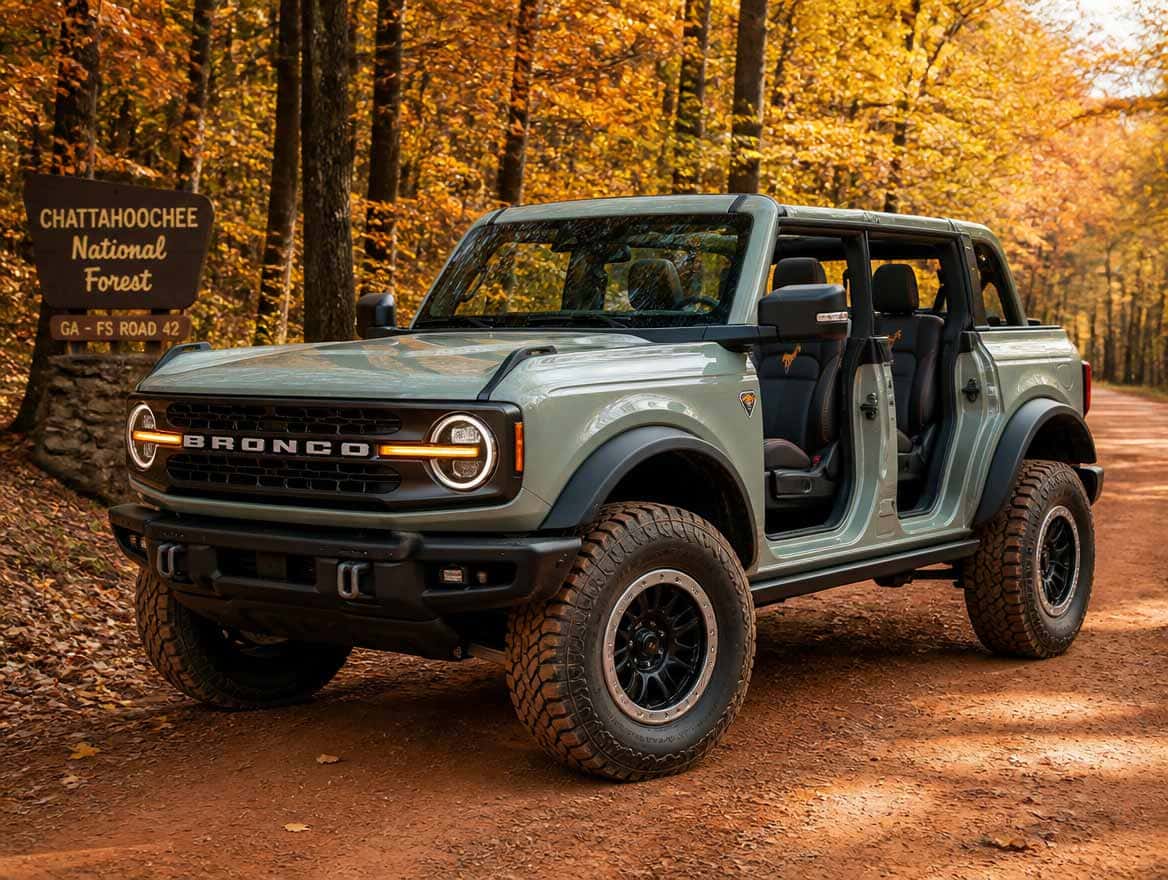
Fall in Fayette County rolls in fast. The humidity breaks, the light changes on the pine lines along GA-54, and every weekend suddenly feels worth an adventure. If you’ve been circling between a 2026 Ford Bronco and a 2026 Ford Bronco Sport, you’ve probably noticed they look like cousins. A fair question before you commit is whether they drive like cousins, too. They share the name. The platform, the frame, the off-road hardware, and the capability ceiling are a different story. They don’t line up.
Before you sit down with us, the split between them shapes what each one is good for. Sort that out first.
How Do These Two Vehicles Actually Work?
The hardware gap here runs wider than the shared badge suggests, because Ford builds the full Bronco on a body-on-frame architecture shared with the Ranger pickup while the Sport rides on a unibody platform, and that single split drives everything from ride quality to how far each one can climb. That means the body and chassis are separate structures, much like a conventional pickup truck. It’s heavier, more rigid under stress, and designed to handle punishment that would stress a unibody chassis out of alignment. Ford’s 2026 Bronco comes standard with a 2.3-liter turbocharged four-cylinder producing 300 horsepower and 325 lb-ft of torque, with a 2.7-liter V-6 available on select trim levels upping that output to 330 horsepower.
The 2026 Ford Bronco Sport rides on a unibody platform it shares with the Escape. None of that’s a knock. Unibody construction gives it a smoother, more car-like ride on the way to the trailhead, easier daily parking, and respectable fuel efficiency. The bronco Sport’s 1.5-liter EcoBoost three-cylinder puts out 181 horsepower and 190 lb-ft of torque on most trims. The Badlands trim steps up to a 2.0-liter EcoBoost four-cylinder with 250 horsepower and 277 lb-ft of torque. Both engines are legitimate powerplants, but the unibody architecture sets a hard physical ceiling on what the Bronco Sport can handle once the trail gets technical.
Ground clearance and approach geometry tell the real story. Ford lists the Bronco Sport’s maximum ground clearance at 8.8 inches (properly equipped) with an approach angle of up to 30.4 degrees and a departure angle of up to 33.1 degrees. The full Bronco’s Big Bend and Outer Banks trims run approximately 9.4 inches of clearance, the Badlands pushes to 10.5 inches, and adding the Sasquatch Package with 35-inch tires puts you at 11.6 inches. Ford engineers the Bronco’s approach angle at up to 43.2 degrees. That 13-degree difference in approach angle doesn’t sound dramatic until you’re staring at a root-crossed creek bank on a north Georgia forest service road.
Which Bronco Do You Actually Need for Fall Adventures Around Here?
For most fall trips around here the Bronco Sport is plenty, but the answer really turns on where you’re headed and what the road looks like getting there, so start with the route before you start with the spec sheet. Generic Bronco-versus-Bronco Sport articles skip that part. The question isn’t abstract capability. Picture the road first.
If your fall adventures involve gravel county roads south of town, the boat ramp at Lake Horton, a leaf-peeping drive up GA-54 toward Peachtree City, or a weekend at a state park campground with a packed-clay access road, the Bronco Sport handles all of that with ease. Its standard 4WD (no front-wheel-drive option exists anywhere in the lineup), 8.8 inches of clearance, and five G.O.A.T. modes (Normal, ECO, Sport, Slippery, Off-Road) cover the terrain a Georgia weekend usually throws at you. The EPA rates the 1.5-liter trims at 25 MPG city and 30 MPG highway, which makes the round trip to the mountains feel practical. You get real range for a family doing the drive without a gas stop every 200 miles.
The full Bronco earns its keep when the trail gets technical. We’re talking unmarked forest service roads, creek crossings, rutted logging tracks in north Georgia or the Chattahoochee National Forest. Body-on-frame construction absorbs stress a unibody chassis wasn’t designed to handle. The available Sasquatch Package on Bronco adds electronic-locking front and rear axles and 35-inch rugged terrain tires. Pulling the doors and roof panels for an open-air fall run is genuinely different from any crossover experience, and for a certain buyer, it seals the deal.
The tradeoff is real. The full Bronco rides with more body motion on the highway (the upright shape and body-on-frame tuning make that unavoidable), and the EPA estimates approximately 18 city and 22 highway on the 2.3-liter automatic. If you’re commuting up the airport corridor on GA-314 five days a week and camping twice a month, the Sport’s fuel efficiency and smoother daily ride win out. If trail access is the priority and the commute is secondary, the Bronco’s capability ceiling justifies the tradeoff.
Bronco Off-Road Terms, Plain and Simple
| Term | What It Means |
|---|---|
| G.O.A.T. Modes | Goes Over Any Type of Terrain. Ford’s terrain management system that adjusts throttle, transmission shift points, AWD torque split, and stability control for specific surfaces. |
| Body-on-frame | The cab and chassis are built as two separate structures, like a truck. Stronger under off-road stress; heavier and less refined on pavement. |
| Unibody | The cab and chassis are one integrated structure, like most cars. Smoother ride, lighter; has a lower physical ceiling for severe off-road use. |
| Approach angle | The steepest incline a vehicle can climb without the front bumper contacting the ground. Higher is better on technical trails. |
| Sasquatch Package | Ford’s optional off-road package adding 35-inch tires, locking axles, and higher clearance fender flares to qualifying Bronco trims. |
What This Means for Your Next Vehicle
For most drivers here the Sport covers the year comfortably, and the full Bronco only becomes necessary once your plans push past what a crossover chassis can physically handle, so the pick comes down to how often you’re really on rough trail. The Bronco Sport is a genuine trail-capable vehicle, not a crossover wearing a costume. Standard 4WD, 8.8 inches of clearance, and a properly sorted terrain management system put it well ahead of most compact SUVs. For the majority of fall adventures in and around Fayette County, that covers it.
The full Bronco is a different category. It exists for buyers who’d rather cross water, run technical trails, remove the doors on a fall morning, or push capability past what a crossover chassis can physically deliver. The approach angle alone (up to 43.2 degrees, versus the Sport’s 30.4) is why you reach for it when the terrain gets serious.
We carry both in our new inventory, and our team knows the differences cold. Come in and tell us where you’re actually planning to go this fall, and we’ll put you in the right seat, whichever way it leans. A ten-minute conversation there saves a lot of second-guessing later.
Frequently Asked Questions
Are the Ford Bronco and Bronco Sport built on the same platform?
No. The 2026 Ford Bronco is a body-on-frame SUV built on a platform shared with the Ford Ranger pickup. The 2026 Ford Bronco Sport is a unibody crossover built on a platform shared with the Ford Escape. They share a name, similar styling cues, and the G.O.A.T. terrain management system, but they are architecturally different vehicles with meaningfully different off-road capability ceilings.
Does the Bronco Sport have the same G.O.A.T. modes as the full Bronco?
Most Bronco Sport trims (Big Bend, Heritage, Outer Banks) come standard with five G.O.A.T. modes: Normal, ECO, Sport, Slippery, and Off-Road. The Bronco Sport Badlands adds Rock Crawl and Rally for seven total. The full Bronco Badlands also runs seven G.O.A.T. modes, but the hardware underneath the surface (locking axles, Bilstein dampers, higher clearance, body-on-frame construction) means the Bronco can execute what those modes promise on terrain the Sport’s chassis isn’t designed to handle.
0 comment(s) so far on Ford Bronco vs. Bronco Sport for Fall Adventures