


How to Prepare a Ford F-150 for Tropical Rain, Flash Flooding, Blocked Roads, and Extended Outages
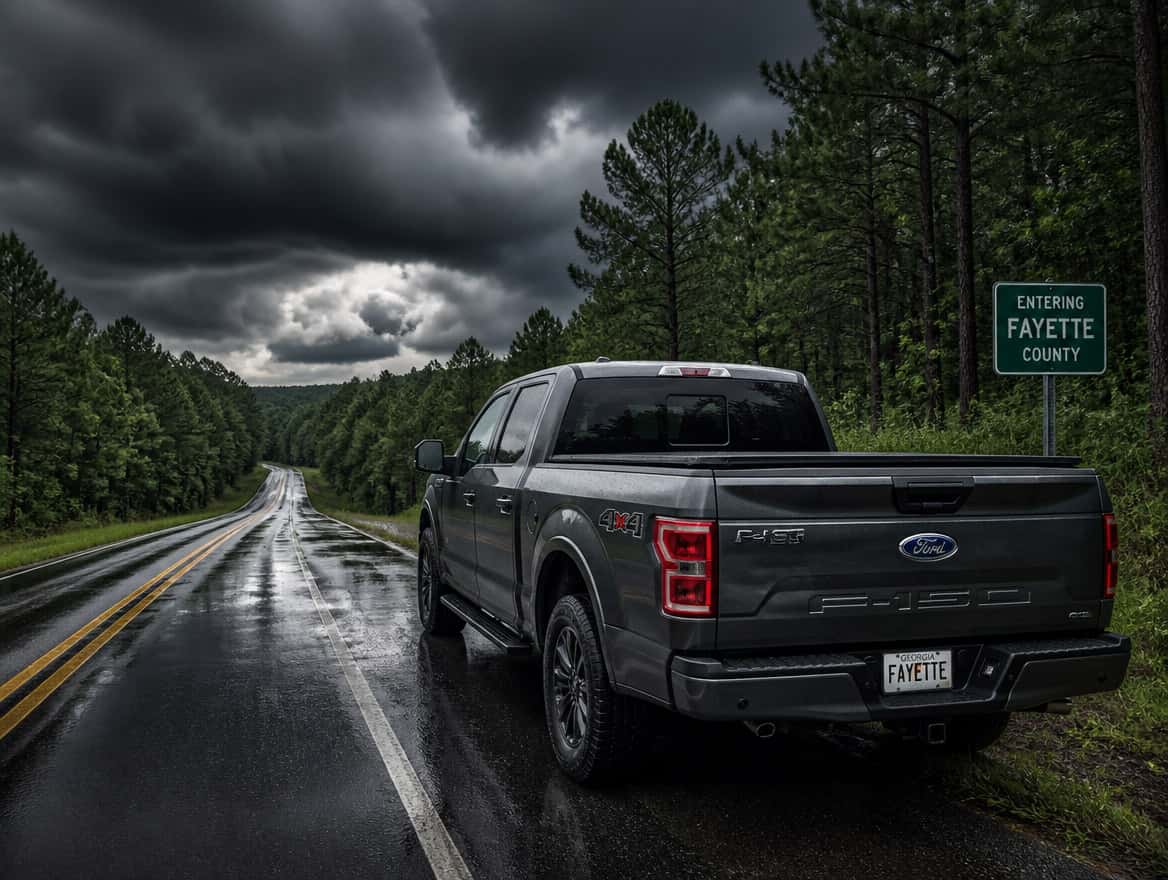
August in Fayette County isn’t always rough, but when a tropical system tracks inland from the Gulf, our GA-85 corridor changes fast. Your 2026 Ford F-150 is genuinely well suited for severe weather. Its capability has real limits, though, and knowing those limits before the rain starts is what keeps you and your family out of trouble.
What Goes on the Checklist?
Work through this whole list before the storm arrives, and you’ll have covered the parts of the truck that actually decide how your day goes once the rain sets in, though a few of these need lead time and can’t be crammed in at the last minute.
Pre-Storm Vehicle Checklist
| Item | Why It Matters | When to Do It |
|---|---|---|
| Check tire tread and pressure | Wet traction collapses on worn tread; proper inflation is more critical in standing water | 48 hours out |
| Inspect wiper blades | Tropical rain is relentless; a split blade is a visibility problem, not a nuisance | Same week |
| Fill the tank completely | Gas stations lose power early; a full tank also extends Pro Power Onboard runtime | Day before |
| Test 4H and 4L engagement | Transfer case seals can sit idle for months; verify it shifts cleanly before you need it | Day before |
| Verify Pro Power Onboard outlets work | Plug in a corded drill or lamp and confirm all bed and cab outlets respond | Day before |
| Load the bed for rear traction | Payload over the rear axle keeps the back tires planted on slick surfaces | Morning of storm |
| Stow a tow strap and recovery board | Even a properly equipped truck can get stuck; gear that’s already in the bed doesn’t cost you time | Keep in truck |
| Check battery terminals for corrosion | Moisture accelerates corrosion; a dead battery during a multi-day outage is an avoidable problem | Week before |
| Confirm rain-sensing wipers (if equipped) | XLT and above may have auto-sensing wipers; a quick test confirms the sensor isn’t blocked | Week before |
| Document the truck’s condition on video | A 60-second walkaround takes one minute and makes hail or debris claims straightforward | Day before |
The Why Behind the Key Items
A handful of these items are obvious on their face, but a few aren’t, and those are the ones worth slowing down on, because the details behind them actually change what you decide to do when a tropical system is bearing down on Fayette County.
Pro Power Onboard and the outage case. Most storm-prep guides fixate on go-bags and tire pressure, and they skip the truck’s built-in generator entirely. Ford’s available Pro Power Onboard system turns the F-150 into a mobile power station with no separate machine to refuel, store, or start out in the rain. On gas-powered models with the 2.7L EcoBoost, 3.5L EcoBoost, or 5.0L V8, Ford lists 2.0 kW of exportable power through standard 120V outlets. Step up to the available 3.5L PowerBoost Full Hybrid and that standard output jumps to 2.4 kW, with an available 7.2 kW configuration that adds a 240V outlet in the bed. That 7.2 kW number earns its keep, because it can run a window AC unit, a sump pump, and a full-size refrigerator at the same time. For comparison, Ford notes a standard portable generator typically caps around 4.0 kW, and unlike a portable generator, it doesn’t sit on a flooded garage floor.
Pro Power Onboard comes with one catch, and it’s fuel. The engine has to run to make power. That’s the tradeoff. Plan on a full tank as your starting point, then load it around essentials so the runtime actually adds up.
The F-150 Lightning pushes this further, with up to 9.6 kW of exportable power drawn straight from its battery pack, no engine running required. If extended outage coverage is your priority, that’s a conversation worth having with our team.
Ground clearance and what it actually means. Depending on configuration, the 2026 F-150 4×4 delivers between 8.4 and 9.4 inches of ground clearance, and the FX4 Off-Road Package reaches the top of that range. FX4 also adds an electronic-locking rear differential, all-terrain tires, off-road-tuned shocks, and steel skid plates that protect the undercarriage against debris in muddy water. Its available Slippery and Mud/Rut drive modes adjust throttle response and traction control for low-grip, wet surfaces.
All of that is real, useful capability, and it isn’t unlimited. We’ll be straight with you here. The F-150’s front bumper sits lower than the ride height suggests, and the National Weather Service is clear that moving water as shallow as six inches can affect vehicle stability and steering. The truck’s ground clearance advantage helps you stay mobile on saturated ground and read shallow water crossings better than a car can. It doesn’t make driving through active flood currents safe. When the NWS posts a Flood Warning on the Flint River near Griffin (which has directly affected the south end of Fayette County before), stay put.
Why 4L matters more than most people realize. Dropping into 4L gives you maximum torque multiplication and precise throttle control at low speed. Creep through six inches of standing water at two miles per hour in 4L, and your tires stay in far better contact with the road than they would at speed. Speed is the enemy. Rolling fast forces water into intakes and differentials, so slow and deliberate wins every time.
The airport corridor and fuel logistics. Plenty of Fayette County residents run GA-85 north toward Hartsfield-Jackson on early shifts. When tropical systems hit this part of the south metro, that corridor floods before the major highways do. Running on half a tank is a normal habit around here. With a storm 24 hours out, fill it all the way and treat that as your baseline.
Schedule Your Pre-Storm Service Check
Frequently Asked Questions
Can my F-150 actually drive through flooded roads?
Your 2026 F-150 4×4 has real advantages: between 8.4 and 9.4 inches of ground clearance (per Ford’s published specs), available Mud/Rut and Slippery drive modes, and an electronic-locking rear differential on FX4-equipped trucks. That said, the National Weather Service notes that moving water as shallow as six inches can affect vehicle stability, and water that reaches intake or differential level causes serious mechanical damage regardless of truck capability. The practical guidance: assess depth from outside the vehicle, only cross standing (not flowing) water, engage 4L, move slowly, and turn around any time the road surface isn’t visible below the waterline.
How much of an outage can Pro Power Onboard cover?
It depends on your powertrain. Gas-powered F-150 models with the optional Pro Power Onboard deliver 2.0 kW through standard 120V outlets, which comfortably runs lights, phone chargers, and fans. The available 3.5L PowerBoost Full Hybrid with the optional 7.2 kW upgrade can simultaneously run a window AC unit, a refrigerator, and a sump pump. The practical limit is fuel: the engine runs to produce power, so a full tank going into the storm is the starting point for any meaningful runtime. If you want outage coverage that doesn’t consume fuel, ask our team about the F-150 Lightning’s 9.6 kW vehicle-to-home export capability.
Print-and-Go Storm Recap
See our current F-150 inventory if your truck doesn’t have the 4×4 setup, FX4 package, or Pro Power Onboard that this kind of weather demands, and for everyone else, here’s the fast version you can run through the morning a tropical warning posts.
48 hours out:
- Fill the tank completely, not halfway.
- Check tire pressure cold, before driving anywhere.
- Test 4H and 4L engagement in an empty parking lot.
- Confirm Pro Power Onboard outlets are functional with a real load.
- Pre-charge all essential devices and a portable battery bank using Pro Power now, before the outage starts.
Day of storm:
- Secure the bed. Loose cargo at 60 mph of storm wind becomes a projectile.
- Pull a video walkaround of the truck’s current condition for your insurance record.
- Monitor NWS alerts for Fayette County specifically, including any Flood Warning on the Flint River near Griffin, which has historically put parts of the south county under water.
- If GA-85 is flooding, leave earlier or stay put. Don’t wait for the road closure sign.
- Engage Slippery mode on wet pavement before the conditions worsen, not after you’ve already slid.
During and after:
- Never cross water where you can’t see the road surface. No exception, no matter how capable the truck is.
- After any significant water crossing, apply your brakes gently at low speed a few times to dry the rotors and check for dragging.
- If the truck was in deep water (at or above the running boards), schedule a differential fluid inspection before your next long drive.
0 comment(s) so far on How to Prepare a Ford F-150 for Tropical Rain, Flash Flooding, Blocked Roads, and Extended Outages