


Ford Maverick vs. Ranger: Which Truck Fits Fayetteville Drivers?
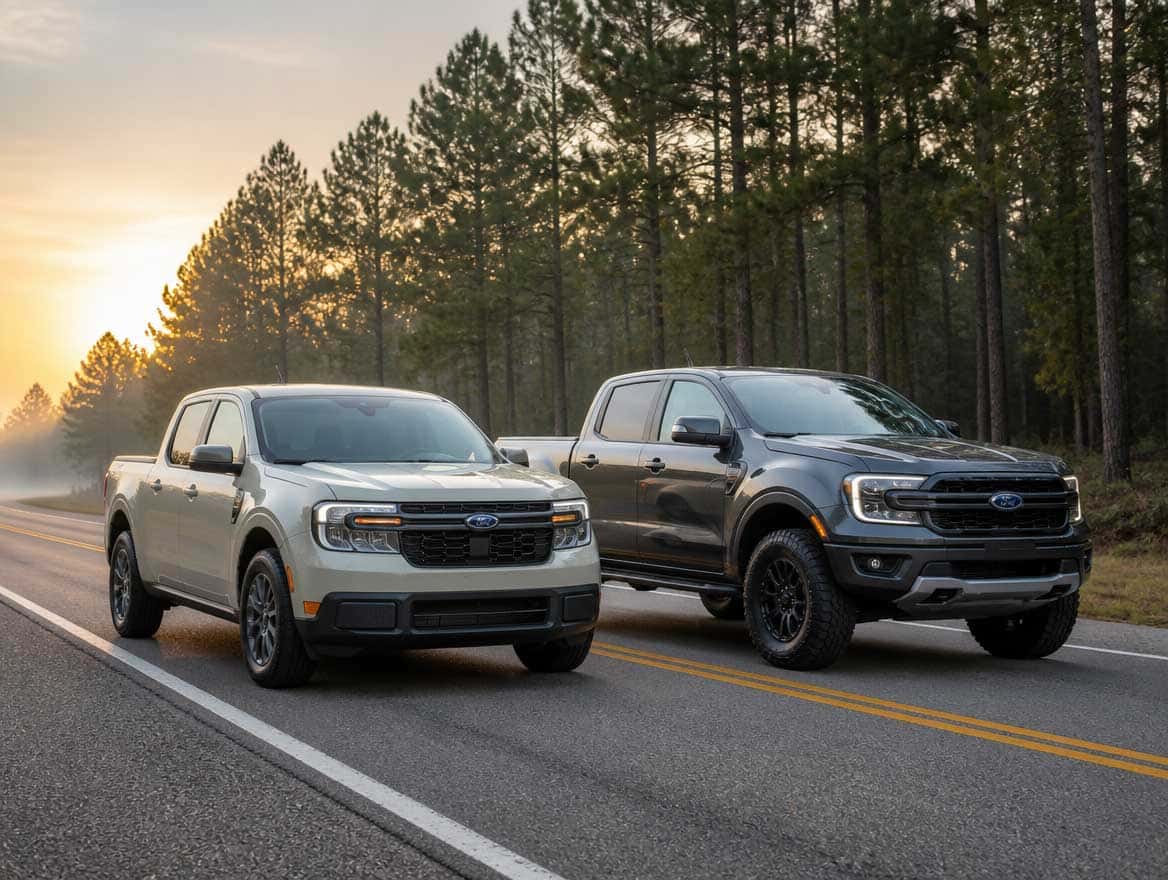
Both are real Fords. Both seat five. But they’re built for different lives, and picking the wrong one is an expensive lesson.
The 2026 Ford Maverick is a compact, unibody hybrid hauler that makes genuine financial sense for Fayetteville commuters running GA-85 every morning. The 2026 Ford Ranger is a body-on-frame midsize truck with serious towing muscle and a bigger bed that contractors and weekend haulers will put to work. Which one belongs in your driveway comes down to a single question. Does your week revolve around miles, or around pounds?
- The Maverick Hybrid earns an EPA-estimated 42 mpg city, which matters over a 20-mile commute to the airport corridor and back.
- The Ranger tows up to 7,500 lbs when properly equipped, the Maverick tops out at 4,000 lbs with the optional 4K Tow Package on AWD models.
- The Ranger’s bed is 59.6 inches long and holds 43.5 cubic feet; the Maverick’s FLEXBED runs 54.4 inches and 33.3 cubic feet.
- Both seat five in a SuperCrew cab. The Maverick is roughly 11 inches shorter overall and rides on an unibody platform; the Ranger is body-on-frame.
- Our team’s honest read: commuters and light haulers belong in the Maverick; anyone towing a real trailer or loading a real work bed belongs in the Ranger.
What’s the Real Difference Between These Two Trucks?
The core difference is architecture, and it drives nearly everything else you’ll notice behind the wheel. The Maverick rides on a car-style unibody platform shared with the Ford Escape, while the Ranger sits on a fully boxed high-strength steel body-on-frame. One structural fact drives almost every difference below.
| Category | 2026 Ford Maverick | 2026 Ford Ranger |
|---|---|---|
| Platform | Unibody | Body-on-frame |
| Standard Engine | 2.5L Hybrid (191 hp) | 2.3L EcoBoost I4 (270 hp / 310 lb-ft) |
| EPA Combined MPG | Up to 38 mpg (Hybrid FWD) | Up to 23 mpg (2.3L RWD) |
| Max Towing (properly equipped) | 4,000 lbs (with 4K Tow Package, AWD) | 7,500 lbs |
| Max Payload | Up to 1,500 lbs | Up to 1,767 lbs (2.3L RWD) |
| Bed Length | 54.4 in (4.5 ft) | 59.6 in (5 ft) |
| Bed Cargo Volume | 33.3 cu ft | 43.5 cu ft |
| Overall Length | ~199.7 in | ~210.6 in |
| Ground Clearance | 8.1–8.3 in | 9.3 in |
Unibody design is why the Maverick rides so smoothly, and why it earns hybrid efficiency at all. It caps towing, too. Body-on-frame construction is why the Ranger can pull 7,500 lbs and shrug off real work loads, and it’s why the ride firms up when the bed sits empty.
Does the MPG Difference Actually Move the Needle for Fayetteville Commuters?
It does, and the gap is wide enough to feel across a year of commuting, as long as your week runs on miles instead of pounds. Walk through the math in plain terms, and we’ll keep dollar figures out of it.
Hartsfield-Jackson Atlanta International Airport sits roughly 20 miles north of Fayetteville on the GA-85 and I-85 corridor. A round-trip commute runs about 40 miles, with real stop-and-go at both ends, and that’s exactly where the Maverick Hybrid’s EPA-estimated 42 mpg city rating earns its keep. The EPA rates the standard Hybrid FWD at 42 city and 35 highway (38 combined); with AWD it runs 40 city and 34 highway. A Ranger equipped with the 2.3L EcoBoost and rear-wheel drive returns an EPA-estimated 21 city and 25 highway (23 combined).
Side by side, you’re looking at roughly a 65 percent efficiency gap in city conditions. Stretched across a year of airport-corridor commuting, the Maverick Hybrid returns substantially more miles per tank, which is the kind of math that stacks up quietly.
The 2026 Ford Ranger earns that fuel concession back the moment the work starts. Its 270-horsepower 2.3L EcoBoost (310 lb-ft of torque) has the pull a Fayette County tradesperson leans on while loading material through the week. The Maverick’s EcoBoost option steps up to 250 hp and 280 lb-ft, which is capable, but it’s a car engine making truck sounds, and towing at its limit over long hauls will remind you of that.
Explore financing options to figure out the ownership picture before you commit to either.
Bed Size and Payload: Is the Maverick Bed Actually Useful?
Yes, and the Maverick bed earns real weekend duty, though there’s one caveat worth naming before you trust it on a job. Match the bed to the work you actually bring it.
The Maverick’s FLEXBED measures 54.4 inches at the floor and holds 33.3 cubic feet. The width between wheel wells is 42.6 inches. You’ll fit two mountain bikes upright, a standard load of mulch bags or pavers, or a full sheet of plywood when you drop the tailgate and let it hang. Ford built FLEXBED slots directly into the bed walls for DIY dividers (smarter than it sounds for a working homeowner).
The Ranger’s bed runs 59.6 inches long and 43.5 cubic feet. Call it 10 more cubic feet and 5.6 more inches of length. Between the wheel wells you’ll get 48.2 inches (5.6 more than the Maverick), which is enough to lay a 4-foot-wide item flat without angling it. For a tradesperson who routinely loads lumber, pipe, or equipment cases, that 5 inches matters.
| Use Case | Maverick FLEXBED | Ranger 5-ft Bed | Winner |
|---|---|---|---|
| Weekend mulch / lumber run | Handles it (bed + tailgate) | Handles it more easily | Ranger |
| Mountain bikes, kayak, camping gear | Fits comfortably | More room to breathe | Ranger |
| Tool bags, small equipment | Fine | Fine | Tie |
| Daily commuter cargo (bags, gear) | More than enough | Overkill | Maverick |
| Towing a loaded trailer alongside bed use | Payload tight at 1,500 lbs | Up to 1,767 lbs payload | Ranger |
One honest caveat holds. For quarterly Home Depot runs and daily life, the shorter bed never comes up. Haul plywood weekly for a job, though, and you’ll feel it.
Ride, Size, and Living With Each Truck Daily
The Maverick is roughly 11 inches shorter overall than the Ranger (199.7 in vs. 210.6 in). In practical terms, on a south-metro Georgia parking lot, that’s meaningful. Suburban retail strips, the tight rows at Peachtree City shopping centers, standard residential garages, the Maverick fits places the Ranger has to think about.
Check the ground clearance. The Ranger’s 9.3 inches edges the Maverick’s 8.1-to-8.3 inches, and no one calls that a dramatic off-road advantage in everyday Fayette County driving, but it’ll matter when someone hits the unpaved back entrance of a job site or pushes through standing water after one of those late-afternoon thunderstorms that roll through hard every summer.
Ride quality separates them more than the spec sheet admits, and you’ll notice fast. The Maverick’s unibody platform soaks up road imperfections the way an SUV does. A stiffer setup defines the Ranger, especially unloaded. Body-on-frame trucks are built to carry weight, and they feel that way empty. Airport shift workers and film-industry commuters coming up from Trilith Studios who spend 40 minutes each way on pavement will feel that distinction by the end of month one.
Pros and Cons: Maverick vs. Ranger at a Glance
| 2026 Ford Maverick | 2026 Ford Ranger | |
|---|---|---|
| Pros | 42 mpg city (Hybrid FWD, EPA-estimated) | 7,500-lb towing when properly equipped |
| Unibody ride comfort for daily commuting | 1,767-lb payload (2.3L RWD) | |
| Shorter overall length. Easier to park | Body-on-frame durability for real work | |
| FLEXBED slots for DIY organization | 43.5 cu ft of bed space | |
| Hybrid included as standard (no upcharge) | 270-hp 2.3L EcoBoost standard; V6 available | |
| Cons | Max 4,000-lb tow (requires AWD + 4K Tow Package) | 23 mpg combined in the efficient config |
| 33.3 cu ft bed. Smaller than segment rivals | Stiffer ride when unloaded | |
| Not body-on-frame. Rated for lighter work | Longer footprint. Tight parking is a real issue |
So Which Truck Should You Actually Pick?
The pick splits cleanly by how you really use a truck, so match the profile below to your week, and you’ll have your answer fast. Our team sorts it by buyer type.
Pick the Maverick if: you commute the GA-85 corridor to the airport or to Trilith most days, your hauling is light (seasonal projects, weekend runs, daily cargo), and you want a truck that’ll genuinely fit in traffic without needing an exit strategy for parking. The Hybrid makes the mpg case on its own. The unibody ride makes the commute livable.
Pick the Ranger if: you regularly pull a trailer, a boat, or equipment that weighs more than 4,000 lbs. If you’re a Fayette County contractor loading job-site material weekly. If you want a truck that grows into real work as your projects get bigger. The body-on-frame frame and the 7,500-lb properly-equipped tow rating aren’t marketing numbers. They’re structural decisions Ford made for serious haulers.
The Maverick carries one genuine downside. 4,000 lbs is its ceiling, and it can’t grow past it. If your towing needs sit at that limit today, you’ll outgrow it by next year. Buy the Ranger now and be done with it.
Both are in our inventory at Stivers Ford South Fayetteville, and we’re glad to put you in either one.
See What Your Current Vehicle Is Worth
Frequently Asked Questions
Can the Ford Maverick tow a boat trailer?
It depends entirely on the boat and setup. The base towing rating on both engines is 2,000 lbs. With the available 4K Tow Package on AWD models, that rises to 4,000 lbs when properly equipped. A small aluminum fishing boat or personal watercraft trailer often falls in that range. A heavier bass boat or a tandem-axle pontoon usually doesn’t. Check the gross trailer weight of your specific rig first, and factor in the tongue weight. The Ranger is the safer call if you’re near or above 3,500 lbs on a regular haul.
Does the Ranger ride rough for everyday driving?
Rougher than the Maverick, yes, especially unloaded. That’s a structural reality of body-on-frame construction: the truck is engineered to carry weight, and it’s most composed when it has some. For a pure daily commuter who never loads the bed, the Maverick’s unibody ride is a good deal more car-like. Buyers who do put the Ranger to real use. Loaded beds, towing on weekends. Generally say the ride tradeoff is completely worth it because the truck performs the way they need it to. It’s a matter of knowing what you’re buying.
0 comment(s) so far on Ford Maverick vs. Ranger: Which Truck Fits Fayetteville Drivers?